GIANYAR
While the kingdom of Gianyar was forged only in the late 18th century, this verdant territory of valleys and river-ways spawned some of Bali’s earliest settlements. Antiquities here are rife. In and around the village of Pejeng, look for the temples of Penataran Sasih, with its huge bronze kettle drum, Pusering Jagat (Navel of the world), built in the early 14th century, and Kebo Iwa, with its exotic statuary. Nearby, in the Archaeology Museum in Bedulu have some interesting Neolithic artifacts and stone sarcophagi.
The ancient hermitage of Goa Gajah (the elephant cave) is also close at hand. One of Bali’s most visited tourist sites, this complex comprises a man-made grotto, elaborate stone carvings, Stupas and a number of pavilions.
Just North of Tampaksiring lies the sacred spring of Tirta Empul. Legend has it that the gods created this rejuvenating pool after their army was poisoned by the demon king Maya denawa: it has in any case been a holy bath since the 10th century. Nearby is Gunung Kawi (Mountain of poets), an 11th century sanctuary with gurgling springs and rock-cut memorials to long dead kings.
Gianyar is also an excellent place to shop, The highway from Batubulan to Ubud passes through a rapid succession of Villages, each specializing in their own art from, be it gold and silver work, wood carving, sculpting or painting, Ubud it self, 25 km north of Denpasar, has been home to craftsmen, healers and literati for countless generations, and earlier this century become a chic retreat of foreign artists. Ubud caters to its ever-growing complement of tourist with dozens of shops and restaurants and its own tourist information office, three museums, Neka, Puri Lukisan and Agung Rai, display fine works of modern and traditional Balinese art.
BADUNG
Badung Regency, one of the city’s Regency of Bali, has an area that stretches from the North to the South. Splitting the middle of the island of Bali with its unique shape similar to the shape of Keris (Indonesia traditional sword). Keris is typical Balinese weapon in General that symbolize the mighty, warrior soul and unyielding spirit as it had been demonstrated in previous generations in a heroic historical event on September 20th, 1906 known as the Puputan Badung war.
The uniqueness of the area shape and the spirit of the Puputan Badung War then enshrined as the Badung Regency’s symbol with the motto of Cura Dharma Raksaka that has the meaning of Government’s obligation is to protect its people and the truth. Badung Regency has had capital named Mangupura, which was inaugurated in 2009 by the Indonesian Minister of Home Affairs.
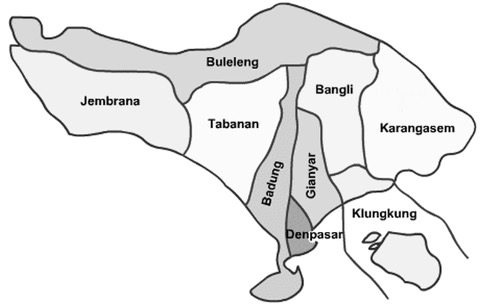
Badung Regency is adjacent to Buleleng regency in the north. In the east it is bordered with Bangli regency, Gianyar Regency and Denpasar city. In the West it is bordered with Tabanan Regency, while in the South it is bordering with the Indian Ocean. Badung also become the gate of Bali Island through Denpasar Ngurah Rai International Airport that is located in the village of Tuban, Kuta, Badung. The Ngurah Rai International Airport also included in the administrative area of Badung Regency.
Badung Regency has many exciting tourist objects, which are scattered around Kuta, Nusa Dua, Uluwatu, Jimbaran, Legian, Seminyak area, Sangeh Monkey forest, Plaga agriculture and Nunung waterfalls.
DENPASAR
The name Denpasar – from the Balinese words “den”, meaning north, and “pasar”, meaning market – indicates the city’s origins as a market-town, on the site of what is now Kumbasari Market (formerly “Peken Payuk”), in the northern part of the modern city
In 1958 Denpasar became the seat of government for the Province of Bali. It remained the administrative centre of both Badung Regency and the City of Denpasar.
Both Denpasar and Badung Regency have experienced rapid physical, economic, social and cultural growth. Denpasar has become not only the seat of government, but also the centre of commerce, education, industry, and tourism.
Attractions in Denpasar (the capital city of Bali) include several sites of historical and cultural significance, such as the Sakenan Temple on the island of Serangan, and the Jagatnatha Temple that is adjacent to town’s public museum. Denpasar offers a blend of rustic touches and urbane features that make it a unique place to visit on your Bali holiday.
In the center of Denpasar you will find a rather bustling scene, but if you travel to its outer fringes there is a more laidback natural vibe, and comfortable areas to behold, such as the mangrove forest in southern Denpasar and the Kertalangu Cultural Village in the northeast. You can enjoy a day trip starting from the heart of the city with many of these sites a short distance apart. Here are the 10 best attractions to see in, and around, Denpasar Town.
TABANAN
Sweeping down from a densely forested volcanic crest to a shoreline of long, sandy beaches and rocky outcrops, Tabanan offers a dramatic mix of terrain and landscapes, Gushing rivers and steep ravines traverse the countryside of this prosperous regency, bringing life-giving water to one of Bali’s most productive rice growing areas.
Tabanan’s most popular tourist site is Tanah Lot (Earth from the sea), a 15th century temple built above the sea on a rocky outcrop. At high tide, Tanah Lot is completely surrounded by water; there is a holy spring at the outcrop’s base and poisonous sea snakes “keeping guard” over the holy site from caves along the shore. Tourists, however, are no longer allowed to climb up the temple.
The regency’s rugged, awe- inspiring shoreline is a world apart from the cool highlands around Bedugul, some 1,400 meters above sea level, this sleepy mountain town and the calm waters of Lake Bratan offer a welcome retreat from the heat and bustle of coastal Bali. Hike along the forested hills or stroll through the Kebun Raya Eka Karya botanical gardens.
BULELENG
Bali’s chief port in Dutch colonial times, this town received many influences from foreign traders; Singaraja has numbers of Chinese Temples and colonial buildings. The Gedong Kertya Library has huge ranges of lontar (palm leaf) scriptures collections covering many issues including traditional literature, medicinal formula, black magic and many more.
Drive along the coastal area of Lovina heading west trough the tobacco plantations and hill views on your left, allowing you to enjoy the different atmosphere of the west side of Bali. Drive through a narrow village street and find the Banjar Tegeh Hot Spring. These slightly sulphuric hot springs are well worth visiting. Set slightly back in the hills, dragon fountains pour hot water into a tiered bathing pool.
Pulau Menjangan, or internationally known as the Deer island, located 79 km west of Singaraja, is one of the most famous marine parks in the world. Rare and protected Java deer inhabit this small island; however visitors usually come for diving and snorkeling.
About 16 km south of Singaraja, is located the impressive Gitgit Waterfall, which cascades into a small lagoon in plantation of coffee and clove trees.
JEMBRANA
This regency was established in the early 1400s, although civil war broke out and the regency became part of Badung Regency. In the late 17th century, sparsely populate Jembrana was not of the much of interest to the other royal Balinese Kingdoms and for a time it was ruled over by a prince from Sulawesi. Jembrana was the first Kingdom to surrender to the invading Dutch in the 1800s.
Jembrana is best known for the Makepung – traditional buffalo races. The regency even calls itself the land of the Makepung. The Makepung, which consists of a race between two carts pulled by water buffaloes, was originally held as part of the harvest festivities. The carts and buffaloes were, until quite recently, still used for transport in Perancak, a race can be arranged to order. If you like, you can be your jockey. There is a small temple of white stones to commemorate the landing of Sang Hyang Nirartha. A Crocodile farm commemorates the now extinct Perancak Crocodiles, tigers, jalak putih, the phoenix bird of paradise, and many more.
BANGLI
Bali’s only landlocked regency compensates for its coastal deficit with some of the most spectacular scenery on the island. Shaped like a ragged keyhole. Bangli has endured a history of internecine warfare and occupation and was one of the first kingdoms to fall to the Dutch Empire. The administrative centre of the regency is Bangli town, in the south, where cool, fresh air complements the manicured roadside of this pretty city.
The regency’s main road climbs gently upwards through bamboo forests and dry upland terraces until at 1,500 meters above sea level, the great maw of the Batur Caldera opens in front of you Eleven kilometers in diameter and 183 meters deep, this enormous basin was carved out 30,000 years ago when Bali’s larges volcano blew itself to pieces. Dominating its centre is Mount Batur a brooding, black end cone that has erupted four times this century. Another quarter of the basin is filled by a beautiful crescent shaped lake named Lake Batur.
The most extraordinary Bangli village is Trunyan, a jumbled collection of cinder-block houses pressed against the eastern shore of the lake. Adhering to pre- Hindu practices, the residents of Trunyan choose not to cremate their dead but to lay them out in the nearby ravine, exposed to the embalming perfume of a sacred tree.
Across the lake, the village of Toya Bungkah has volcanic hot springs, with small plunge pools.
Back along the crater’s rim are two important temples. Pura Ulun Danu Batur, a large and ornate sanctuary dedicated to the goddess of the lake, was originally located on the shores of Lake Batur. In the 1920s, it was moved to its current location near the market town of Kintamani, after narrowly escaping destruction by lava flows. Further up, at Penulisan just before the road begins its long descent to the north shore. A steep flight of steps leads to Pura Tegeh Koripan, which at 1,745 meters is the highest temple in Bali.
KLUNGKUNG
It was in this part of Bali that the fleeing royalty of the Majapahit dynasty set up their kingdom. Between the 14th and 19th centuries Samprangan, Gelgel & Klungkung were all capitals of the Klungkung Regency. Recognized by other Balinese kingdoms as the most powerful, this regency was one of the last strongholds of the Balinese during the Dutch invasion of 1900’s. The Gelgel dynasty ruled in Bali for over 600 years and throughout their reign the arts flourished.
Klungkung Regency Capital – This busy market town on the main route to Besakih and Amlapura is steeped in history and has some noteworthy sites, the Semara Pura Palace complex which houses the Hall of Justice and Kambang Pavilion. The market here sells interesting textiles woven in the eastern part of Bali, one thing to buy is sea salt panned from the nearby beaches.
Kerta Gosa- Judgment Hall – A Hall of Justice that functioned as the highest seat arbitration in the kingdom. The ceiling friezes depict scenes of horror and punishment. Villains judged here were imprisoned on Nusa Penida Island.
Bale Kambang – This floating pavilion is adjoined to the Judgment Hall; the ceiling friezes here depict scenes of Buddhist folklore and astrology
Bat Cave – Goa Lawah – A cave said to house the scared serpent that guards holy Mount Agung and the cosmos. Teeming with bats, this cave has various passageways, some up to 30kms long, in fact it is said that one leads all the way to the Temple of Besakih.
Lembongan & Ceningan Islands – the sub islands of the east coast of Bali, with a number of caves and beaches to explore. Lembongan is a very popular one-day cruise destination.
Penida Island – Originally the penitentiary island for the Klungkung kingdom. The Dalem Peed Temple is associated with myth and black magic.
KARANGASEM
Mount Agung (3,142 meters), towers majestically over eastern and northern Karangasem. The most disastrous volcanic eruption took place on 17th march 1963 when Agung literally blew its top. Streams of lava and hot volcanic mud poured down to the sea in the southeast of the island, covering roads and isolating the eastern end of the island. The whole island was covered in ash and crops were wiped out.
This day mount Agung is quiet and the mother temple Pura Besakih perched 1,000 meters up the slope attracts a steady stream of devotees and tourists. Pura Besakih is Bali’s most important and probably best-kept temple, comprising about 30 separate temples on seven terraces rising upwards.
Padang Bay is the port for the ferry service to Lombok. It’s a sleepy fishing village situated in a perfectly sheltered bay. The beach is picturesque and quaint with a long sweep of sand where colorful boats are drawn up on the beach.
From Padang Bai, the road follows a beautiful stretch inland and turns off at the mountain village of Tenganan. This is a Bali Aga village one of the few Balinese communities to resist the Majapahit invasion of 1343. It is a walled village consisting of two rows of identical house sand is the only place in Indonesia where double- weaving (Tenun ikat, Geringsing is produced. The village is also famous for its Lontar sacred books.
One the coastal road 13 kilometers from Tenganan is the one – quite fishing village of Candi Dasa. There are fantastic views from the headland and on a clear day Mount Agung rises magnificently behind the range of coastal hills.
The main town and capital of Karangasem regency is Amlapura, Puri Agung Karangasem palace is an imposing reminder of the time when Karangasem was a kingdom. It has a three- tiered gate and beautiful sculptured panels on the outside.
Six kilometers from Amlapura, you will find the Tirta Gangga water palace. The palace built in 1947 by Amlapura’s water loving king, is a place of beauty and solitude. The palace comprises a network of pools and a swimming pool and beautiful rice terraces as its backdrop.
North of Tirta Gangga is Tulamben, where you can dive to see the SS Liberty, the American war ship sunk by the Japanese in 1942. It’s a long way from anywhere on this barren coast, but worth a pause on your travels.